The Vamp : a cinematographic version of the femme fatale
Part 1 : text by Mathilde Montet, editing Mélissa Airaudi

Marlène Dietrich as Lola Lola, 1930
In the 1910s, as Hollywood was beginning to establish itself as the center of film production, a new myth emerged: the vamp, a seductive female figure who leads to ruin the men who seek to possess her.
The term “vamp” was first used in 1915 to describe the character played by Theda Bara in A Fool There Was. She succeeds in fascinating and dominating a wealthy diplomat, stripping him of his sanity, his family, and his fortune like a vampire, and ultimately witnessing his inevitable suicide.
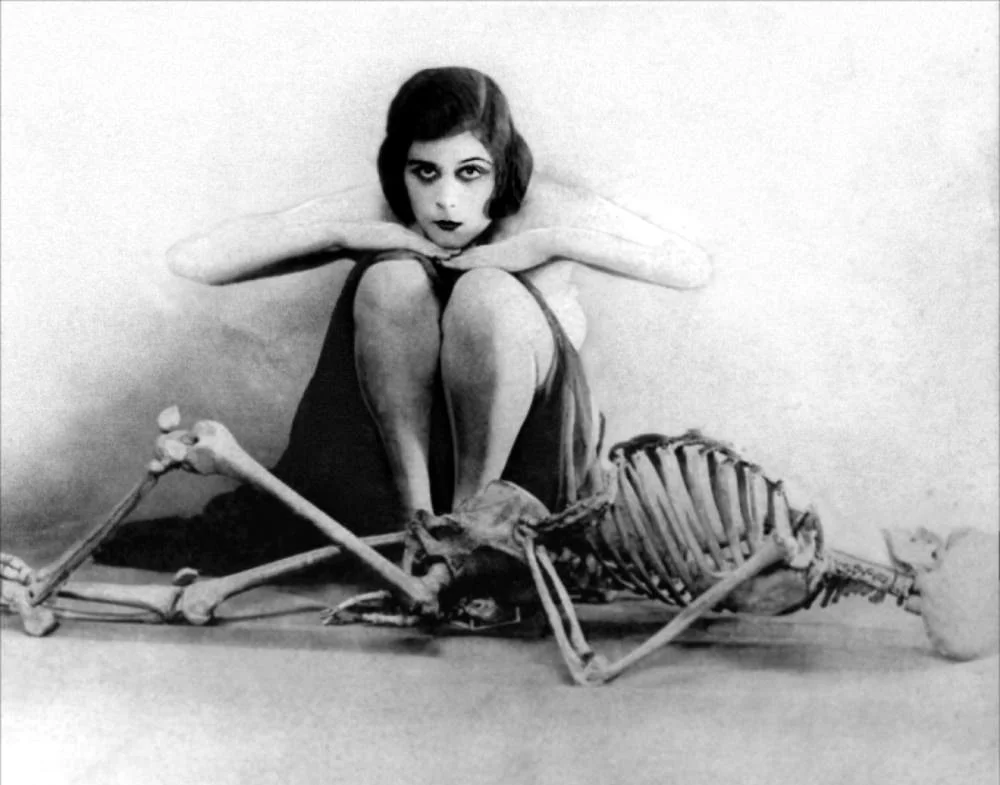
Theda Bara poses with a skeleton for a promotional photoshoot of « The Fool There Was », 1915
In her wake, vamp characters multiplied. In the crime fiction of the 1920s and 1930s, iconic actresses captivated audiences through a hypnotic physicality driven by dance and acrobatics, as well as through their sultry, unconventional performances. Their names include Musidora in France, Lina Cavalieri in Italy, and Vera Kholodnaia in Ukraine. Later, vamps became the ultimate feminine ideal in the great American film noirs of the 1940s and 1950s, embodied by icons such as Rita Hayworth and Ava Gardner.
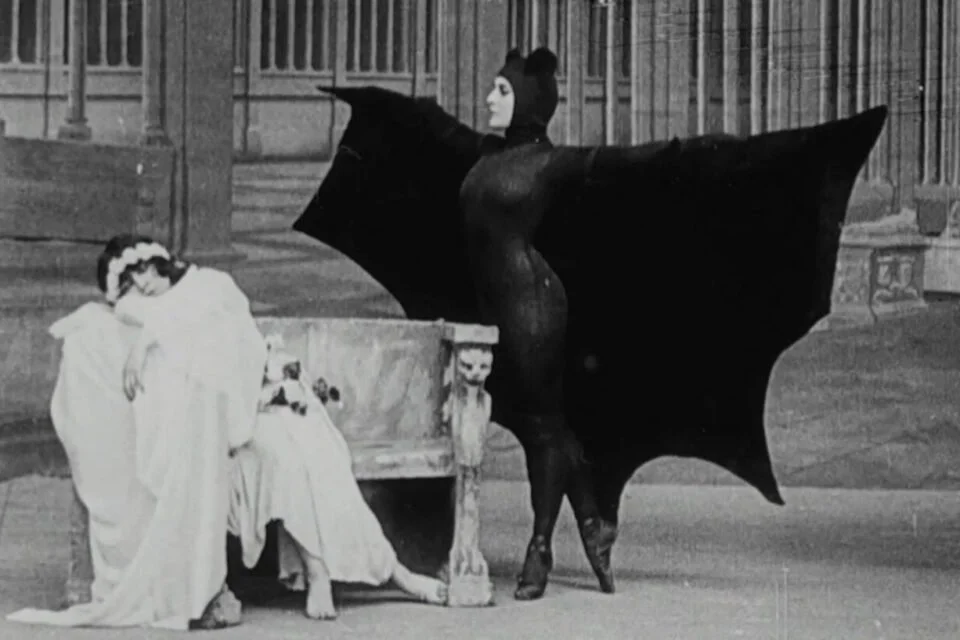
Musidora in the show « Les Vampires », 1915
However, this imaginary figure of a dangerous, venal, and manipulative woman who holds power of life and death over men did not originate in the 1910s. The vamp is the cinematic manifestation of the myth of the femme fatale.
Princess Salome, who enchants King Herod to obtain the execution of Saint John the Baptist in the 1st century BCE, is one of the earliest narratives to feature a female character who uses her power of seduction to achieve her ends. Salome is literally fatal, driven by a desire to kill that ultimately comes to fruition.
Cleopatra VII, the last sovereign of Egypt, has inspired countless fantasies. She conducts an affair with Caesar, then with Mark Antony, at a time when Rome is seeking to turn Egypt into one of its provinces. Political intrigue and romantic entanglement become inseparable. Throughout her life, the pharaoh maneuvered to preserve Egypt’s independence. Roman authors would later reduce her to a crude caricature, with Horace going so far as to call her a “deadly monster.” A double-edged femme fatale, Cleopatra would meet a romanticized death, poisoning herself in the arms of her Roman lover.
There is often a dark underside to the stories of femme fatales: they die in tragic circumstances, trapped within a patriarchal morality that falls upon them like punishment. Literature abounds with examples of ambitious, seductive women who are condemned at the end of the novel—serving simultaneously as objects of male fantasy and repulsion, and as cautionary tales for women who might dare to emancipate themselves. And yet, these heroines embody the strength of character, the courage and the manipulative skills required to be truly subversive. That is why they’re still inspiring us today !
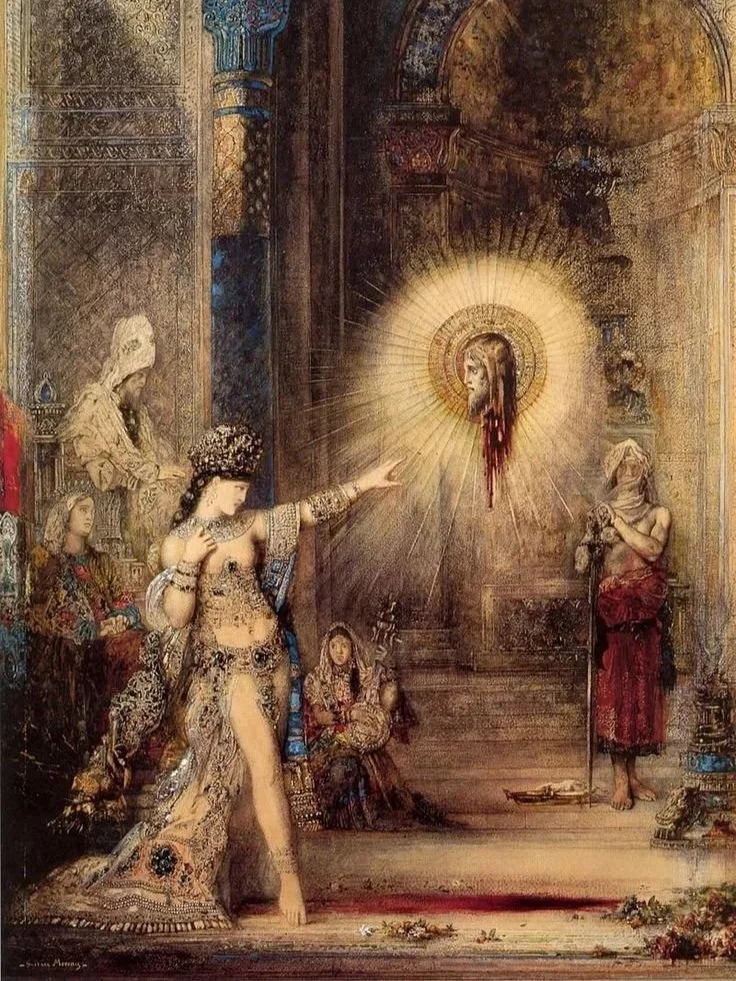
La Danse de Salomé, Gustave Moreau, 1876